
Container Inspections from Customs & Border Protection
According to U.S. Customs and Border Protection (CBP), more than 11 million maritime containers arrive at U.S. seaports and 2.7 million by rail to land borders annually. Customs is required to examine and verify the contents inside these containers and determine if the goods pose a risk to the American people.
Exterior 7-Point Inspection
Prior to loading, stuffing, and/or packing, all conveyances and empty Instruments of International Traffic (IIT) must undergo Customs Trade Partnership Against Terrorism (CTPAT)-approved security and agricultural inspections to ensure the structures have not been modified to conceal contraband or have been contaminated during transport.
Once the inspection has taken place by the CBP it may either be approved and released, require additional assessments, or in the case of contraband the container and goods will be seized and destroyed.
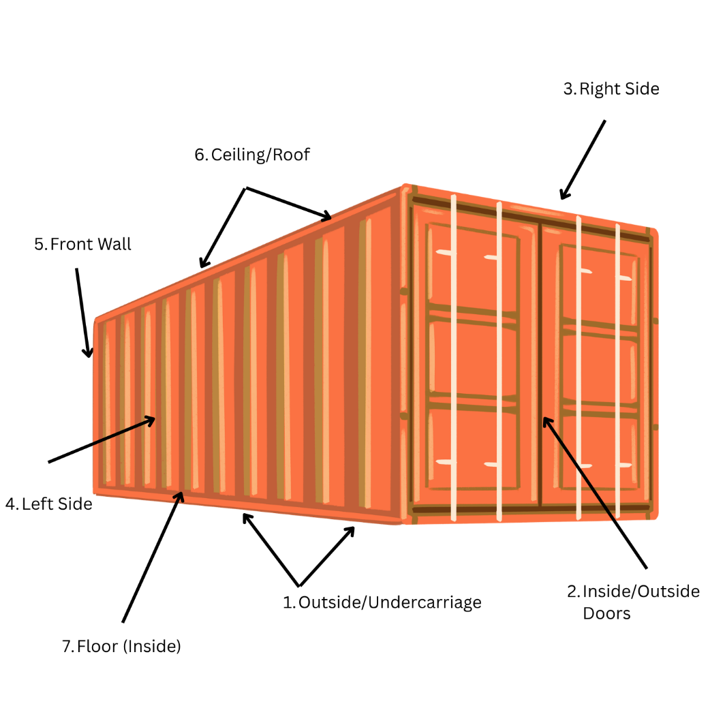
A 7-point inspection checklist is recommended by Customs as an aid for exterior container inspections. It also serves as documentation of the inspection including date of inspection, container number, name of inspector/supervisor, serial number of the seal, and other key information that can be traced back to the empty containers prior to loading/stuffing. More specifically, external hardware such as doors, handles, rivets, and brackets must be intact without signs of tampering. The image below shows all 7 points of an exterior container inspection.
7-Point Container Inspection Checklist
Interior Inspection
Every imported container is subject to a random interior inspection of its contents by the CBP. If a container is flagged for additional inspection, they are required to be routed to a secured and bonded offsite facility known as a Container Freight Station (CFS). These Customs-approved facilities must undergo regulated processing procedures with employee background checks to ensure containers are unloaded and stored safely until a CBP officer conducts its inspection. The CFS partners with CBP in an effort to streamline the inspection process for importers and officers while reducing congestion at the port or rail yard. If Customs requires manipulation of the goods, such as relabeling or repackaging, these facilities can provide additional services required for clearance.
Evans Distribution Systems has reinstated its status as a Customs-approved CFS and is now open for business. Please contact us to schedule a container inspection or for more information about our 3PL capabilities.