
Racking Types, Uses, and How to Choose the Right System
A rack, is a rack, is a rack. Right? Not exactly.
Warehouse racking is a strategic business decision. At Evans Distribution Systems, we take a customer-centric approach to racking systems based on type, quality, customer requirements, product dimensions, layout, operational efficiency, square footage, warehouse ceiling height, and much more. “A 50,000 square foot racking system can cost up to $1,000,000 depending on type and height,” says Rich Huziak, Senior Operations Manager at Evans Distribution Systems. “These decisions should not be taken lightly.” Here are several cases for different racking types to maximize your return on investment (ROI).
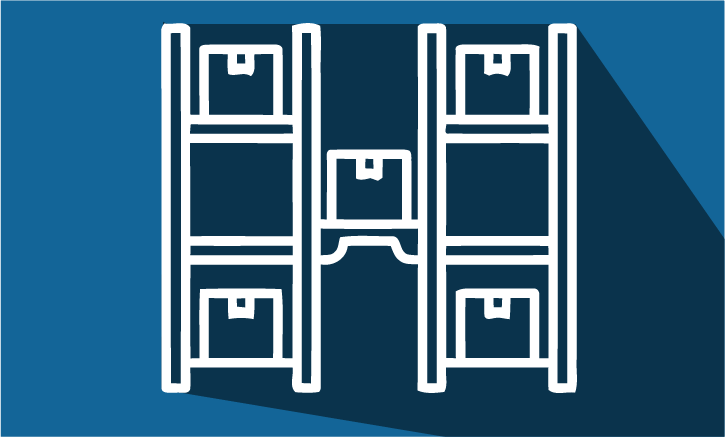
1. Selective Racking
Question: I sell fixture displays for approximately 500 retail stores nationwide. The displays require SKU level tracking because they are store specific and seasonal. Pallets cannot be stacked and a total of 650 outbound less-than-truckload (LTL) shipments will be processed in 6 months. What type of racking should I use?
Answer: Selective racking is a good option for a high SKU, high turn product like retail displays because it allows direct access and visibility to every pallet. Its low storage density requires more square footage, but it optimizes workflow for fast moving goods by eliminating the need to move other products around to gain access.
2. Drive-In or Push-Back Racking
Question: I manufacture furniture that is imported from overseas by container. I require Foreign Trade Zone (FTZ) storage for approximately 500 hundred non-stackable pallets at any given time. Shipments contain 2-5 SKUs and do not require lot control or last in, first out (LIFO). What racking system should I use?
Answer: The most affordable solutions are drive-in or push-back racking systems due to their high-density storage at several depths with one access point for retrieval and unloading. With the large volume and low-to-medium SKU count of heavy/bulky furniture, this system will limit higher FTZ storage fees and benefit from a more relaxed (LIFO) inventory management system.
3. Drive-Thru Racking
Question: I sell liquidated general commodities such as housewares and cleaning supplies to retailers. I require rotating inventory management for approximately 1,200 SKUs with strict adherence to first-in, first-out (FIFO) order processing. Inventory will be received in mixed cases on pallets that require quality control/inspection upon receipt. What racking system should I use?
Answer: Drive-thru racking is designed for high density storage with access to both sides of the rack, making it ideal for FIFO inventory rotation. It also lends well to additional moves related to quality checks and repalletization in a nearby staging area.
4. Pallet Flow Racking
Question: I own a pretzel brand and I’m looking for a food-grade warehouse to ship my products both to retailers and direct-to-consumers. I require inventory control for 50 SKUs and strict adherence to FIFO. On a monthly basis, we ship 2,000 online orders and 60 full pallet retail orders. What racking system should I use?
Answer: Pallet flow racking systems use gravity and inclined rollers to move pallets from the loading side to the picking side automatically. This is ideal for perishable goods that have a strict expiration date. The high-density structure maximizes space and creates a multi-use staging area for B2C and B2B order fulfillment.
5. Double-Deep Racking
Question: I sell gardening equipment to retailers. I have a total of 10 SKUs that are palletized with approximately 150 outbound shipments per month. What racking system should I use?
Answer: A double-deep racking system stores one pallet behind another, effectively doubling storage capacity within the same aisle. Given the consistent turn rate and low SKU inventory this solution will provide the most storage capacity at the most cost-effective rate. Double-deep racking systems long-reaching forklift attachments.
6. Cantilever Racking
Question: I am a decking manufacturer that requires storage for 25-foot-long metal decking bundles weighing approximately 1,500 to 3,000 lbs. On average, I ship 20 single SKU bundles via flatbed every month. What racking system should I use?
Answer: Cantilever racks are designed for long, bulky items like lumber, pipes, or furniture. They feature horizontal arms extending from vertical columns without front obstructions. Given the oversized and irregular shape of the metal bundles this racking system will accommodate your loading and unloading requirements without compromising operational efficiency.
7. Mobile Racking
Question: I require temperature-controlled storage for Class 3 hazmat materials. Each tote weighs 2,200 lbs and requires strict lot control and FIFO. On average we process 2 outbound shipments of 15 totes per month. What type of racking should I use?
Answer: Mobile racking systems are mounted on movable bases that slide along tracks, eliminating the need for multiple aisles. Given that typical warehouse facilities have limited temperature control, a mobile system will accommodate heavy totes and optimize space to meet your unique temperature requirements.
Choosing the Right Racking System
As outlined above, there are key considerations when deciding on a racking solution.
1. Inventory
- Product packaging dimensions
- Number of SKUs
2. Warehouse Layout
- Consider both floor space and vertical height
3. Accessibility Needs
- Access frequency based on inventory turn rate
4. Selectivity vs Density
- High selectivity: Easy access to every pallet
- High Density: Maximum storage with fewer aisles
5. Inventory Rotation (FIFO vs LIFO)
- FIFO (First-in, First-out): Essential for perishable goods; pallet flow or drive-thru
- LIFO (Last-in, First-out): Suitable for bulk storage; drive-in or push-back
6. Material Handling Equipment
- Standard forklifts
- Specialized equipment
7. Return on Investment (ROI)
Some systems have higher upfront costs but deliver:
- Space utilization
- Operational efficiencies
- Profitability
Make Your Racking Investment Work for YOU
There is no one-size-fits-all solution when it comes to warehouse racking. The best system is the one that aligns with your inventory type, operational flow, and long-term business goals. Expert 3PL providers like Evans Distribution assist customers with identifying and sourcing the best racking solution to meet their needs. “When ROI is established, Evans will build racking systems in our facilities to gain those efficiencies,” Huziak says. “These strategic decisions are a true win-win for us and the customers we serve.”
Click here to see a racking comparison guide. Are you looking for a 3PL provider? Talk to an expert today.